
This is Part 2 of our series on cradle-to-cradle thinking in foodservice. In Part 1 we covered the loop in broad strokes. Now we get into the part everyone nods along to but few people can actually explain: how composting works, and why where you compost changes what can be composted.
Composting sounds like rotting. It isn’t, quite. Rotting is what happens when food breaks down without much oxygen, slowly, producing odors and methane. Composting is the managed version: give the right microbes oxygen, moisture, and the right mix of materials, and they break organic matter down quickly, with heat instead of methane, into a stable soil amendment.
Get those conditions right and you have compost. Get them wrong and you have a smelly pile that takes forever. The difference between home and commercial composting is mostly about how well those conditions get controlled.
The four things every compost pile needs
Whether it is a backyard bin or an industrial windrow the length of a football field, composting needs the same four inputs:
- Greens — nitrogen-rich material. Food scraps, coffee grounds, fresh plant trimmings.
- Browns — carbon-rich material. Dry leaves, cardboard, wood chips, and plant-fiber packaging.
- Oxygen — the microbes doing the work are aerobic. Starve them of air and the process stalls and starts producing methane instead.
- Moisture — damp like a wrung-out sponge. Too dry and nothing happens; too wet and you push out the oxygen.
Balance those four, and microbes multiply, generate heat, and work through the material. That heat is the whole game, and it is where home and commercial composting part ways.
Home composting: slower, cooler, limited
A backyard pile, a tumbler, or a countertop bin is real composting, and for food scraps and yard trimmings it works well. But a home pile rarely gets very hot and rarely stays hot. It tops out at moderate temperatures and breaks material down over months.
That temperature ceiling is the catch. A home pile is great for an apple core. It is not reliably hot enough to break down many products that are labeled “compostable,” because a lot of those products are engineered to need sustained high heat to come apart.
This is where labels start to matter. A product certified to TÜV Austria’s OK Compost HOME standard has been verified to break down in home composting conditions. A product certified only to commercial standards has not, no matter what the green leaf on the package suggests.
Commercial composting: hotter, faster, more capable
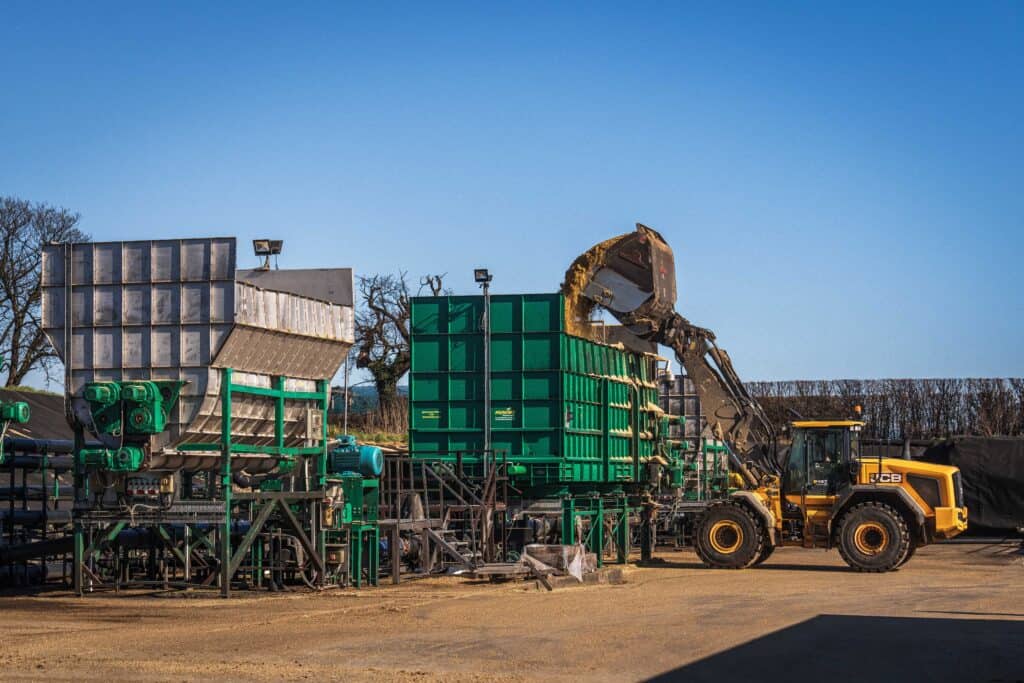
Commercial or industrial composting is a managed operation. Material is mixed to the right green-to-brown ratio, turned or actively aerated to keep oxygen flowing, and held at high temperatures for sustained periods. Those temperatures matter: industrial facilities reach what is called the thermophilic range, commonly cited at roughly 131 to 150°F (about 55 to 65°C), the heat level the certification standards are built around.
That heat does two things. It speeds decomposition dramatically, and it breaks down materials a backyard pile never could. It also kills pathogens and weed seeds, which is part of why finished commercial compost is safe to use on farms.
This is the environment that certified compostable foodservice products are designed for. The main certification standard, ASTM D6400 (with ASTM D6868 covering coatings on paper and fiber products), requires that a product break down in an industrial composting environment within a set window. In practice, that means at least 90 percent of the material converts to carbon dioxide, water, and biomass within about 180 days, while also meeting limits on ecotoxicity and heavy metals so the finished compost is safe for soil. In the U.S., BPI is the main organization that certifies products to those standards.
One detail worth knowing: ASTM D6400 was developed in part because the FTC and state regulators were worried about loose, unverifiable “compostable” and “biodegradable” claims. The standard exists to put science behind the word. That is exactly why a certification beats a green leaf and a vibe.
The two-cups example
Here is the distinction in the most concrete way we can put it.
Take two compostable cups.
- One has an aqueous (water-based) coating. A cup like this can be certified home compostable — it will break down in backyard conditions.
- The other is lined with PLA, a plant-based bioplastic. A cup like this is commercially compostable only — it needs the sustained thermophilic heat of an industrial facility to come apart.
Both are honestly “compostable.” They are not compostable in the same place. We make both kinds, and we are specific about which is which, because telling a customer a PLA-lined cup will vanish in their backyard pile would be exactly the kind of claim this industry has too much of already.
If you only remember one thing from this post: “compostable” is not a single thing. Always ask compostable where?
Why the distinction matters for an operation
If you run a cafe, a cafeteria, or a venue, this is not academic. It determines what actually happens to your products after the meal.
- If your community has commercial composting access, you can use the full range of certified compostable products and they will break down as intended. (Not sure what’s near you? Our composting drop-off map is a place to start.)
- If your customers are taking products home, home-compostable certified items are the honest choice to promote, because that is where they are likely to end up.
- If you have neither nearby, that is a real constraint worth naming rather than papering over, and it is exactly the problem the rest of this series gets into.
Frequently asked questions
What is the difference between home and commercial composting?
Home composting happens in a backyard bin at moderate temperatures and works well for food scraps and yard waste. Commercial composting runs much hotter (roughly 131 to 150°F) and can break down certified compostable products that a backyard pile cannot.
What does “certified compostable” actually mean?
It means the product has been tested against a standard like ASTM D6400 or D6868 and verified to break down within a set time in the appropriate composting environment, while meeting limits on ecotoxicity and heavy metals. BPI is the main U.S. certifier for commercial composting; TÜV OK Compost HOME covers home composting.
Can I put any compostable cup in my backyard compost?
No. Only products certified home compostable are designed to break down in backyard conditions. Commercially compostable products, including many PLA-lined cups, need the sustained heat of an industrial facility.
Is “biodegradable” the same as “compostable”?
No. Biodegradable is a vague term with no fixed timeframe. Compostable means the product meets a defined standard for breaking down into safe compost within a specific window. The two words are not interchangeable.
How long does commercial composting take?
Certification standards generally require the bulk of the material to break down within about 180 days, though actual timelines vary by facility and material.
Learn the difference between biodegradable and compostable.
Next in the series, Part 3: the different ways food waste actually gets processed, from windrows to on-site digesters, and what each one can and can’t handle.